Showing posts with label Heidelberg Catechism. Show all posts

Sunday, January 20, 2013

Tribute to the Heidelberg Catechism

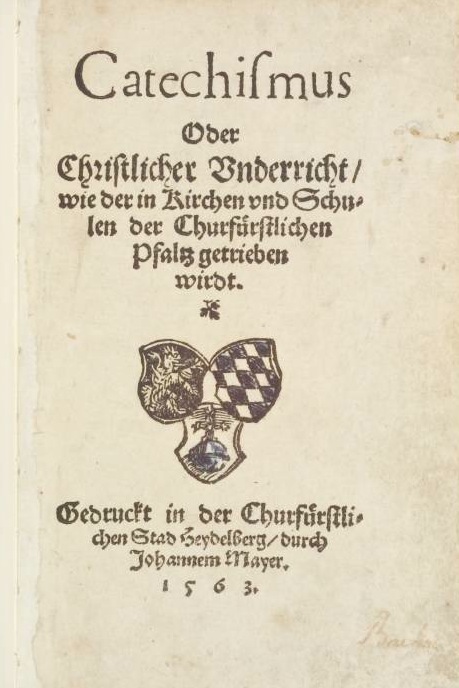
new website containing many valuable resources pertaining to the Heidelberg Catechism has been launched by the Canadian Reformed Theological Seminary on the occasion of its 450th anniversary (it was first published in 1563 and its preface by Elector Frederick III is dated January 19, 1563). (HT: Wes Bredenhof)

Also, Kevin DeYoung has written a helpful encouragement to take this anniversary opportunity to read or re-read this precious spiritual document: Five Reasons to Read the Heidelberg Catechism This Year. Be sure to check these resources out and consider, among other things, the answer to that timeless question, Christian, "What is thy only comfort in life and death?"


Wednesday, April 21, 2010

Protestant Iconoclasm and Art Appreciation

Contrary to Islamic aniconism, which prohibits the representation of living creatures in art, Protestant iconoclasm, mistaken interpretations notwithstanding, has not opposed visual and aesthetic art en masse, but only sought to channel it in ways that accord with the second and seventh commandments. Geraldine Jean Wheeler, Visual Art, the Artist and Worship in the Reformed Tradition: A Theological Study (2003 dissertation), pp. 9-10, writes:

In spite of the widely held view, expressed by Voltaire27 and many others, that Calvin, Geneva and the whole following tradition eschewed art, this can be shown to be misplaced.

27 Quoted in [Jérôme] Cottin, Le regard et la Parole, p. 285, n. 1.

Likewise, the charge that the Puritans were "fanatical Philistines, apostles of gloom, utterly antagonistic to the arts and music" as well as "tone-deaf and colour-blind iconoclasts" has been ably refuted by others.

One need only look closely at the works of Calvin and his followers to see the distinction between opposing ungodly art and allowing art its freedom to blossom within ethical boundaries. Illustrations abound in the Geneva Bible; Huguenot craftsmen such as the potter Bernard Palissy thrived under the Calvinistic appreciation of the arts; the Dutch Golden Age is renowned for its visual arts. The first paintings of Native North Americans were made by Jacques Le Moyne, the French Huguenot painter who survived the Spanish massacre of Fort Caroline, near modern-day Jacksonville, Florida, in 1565. Theodore Beza's classic work, Icones, was not a treatise against images in church, but a collection of biographies of ecclesiastical leaders, accompanied by pictures, or images, of these men. The list goes on...

John Calvin, Institutes 1.11.12:

12. I am not, however, so superstitious as to think that all visible representations of every kind are unlawful. But as sculpture and painting are gifts of God, what I insist for is, that both shall be used purely and lawfully,—that gifts which the Lord has bestowed upon us, for his glory and our good, shall not be preposterously abused, nay, shall not be perverted to our destruction. We think it unlawful to give a visible shape to God, because God himself has forbidden it, and because it cannot be done without, in some degree, tarnishing his glory. And lest any should think that we are singular in this opinion, those acquainted with the productions of sound divines will find that they have always disapproved of it. If it be unlawful to make any corporeal representation of God, still more unlawful must it be to worship such a representation instead of God, or to worship God in it. The only things, therefore, which ought to be painted or sculptured, are things which can be presented to the eye; the majesty of God, which is far beyond the reach of any eye, must not be dishonored by unbecoming representations. Visible representations are of two classes—viz. historical, which give a representation of events, and pictorial, which merely exhibit bodily shapes and figures. The former are of some use for instruction or admonition. The latter, so far as I can see, are only fitted for amusement. And yet it is certain, that the latter are almost the only kind which have hitherto been exhibited in churches. Hence we may infer, that the exhibition was not the result of judicious selection, but of a foolish and inconsiderate longing. I say nothing as to the improper and unbecoming form in which they are presented, or the wanton license in which sculptors and painters have here indulged (a point to which I alluded a little ago, supra, s. 7). I only say, that though they were otherwise faultless, they could not be of any utility in teaching.

John Calvin, Catechism of Geneva (1545), quoted in James T. Dennison, Jr., ed., Reformed Confessions of the 16th and 17th Centuries in English Translation, Vol. 1, pp. 487-488 [on the second commandment]:

144. M[inister]. Does He entirely forbid us to make any image?
C[hild]. No, but He forbids us to make any image with which to represent God, or to worship Him.

148. M. This does not mean that all sculpture or painting is universally forbidden, but only all images used in the service of God, or in worshipping Him in visible things, or indeed for any abuse of them in idolatry of any kind whatsoever.
C. That is so.

Heidelberg Catechism (1563):

Question 96. What does God require in the second commandment?

Answer: That we in no wise represent God by images, nor worship him in any other way than he has commanded in his word.

Question 97. Are images then not at all to be made?

Answer: God neither can, nor may be represented by any means: (a) but as to creatures; though they may be represented, yet God forbids to make, or have any resemblance of them, either in order to worship them or to serve God by them.

Question 98. But may not images be tolerated in the churches, as books to the laity?

Answer: No: for we must not pretend to be wiser than God, who will have his people taught, not by dumb images, but by the lively preaching of his word.
Friday, March 12, 2010

Vanderkamp on the Heidelberg Catechism

Johannes Vanderkamp (1664-1718), The Christian Entirely the Property of Christ, in Life and Death, Exhibited in Fifty-Three Sermons on the Heidelberg Catechism, Vol. 1, Preface, p. xxiii-xxv:

Suffer me, my worthy reader, to detain thee yet a little, while I say something to thee concerning our excellent Heidelberg catechism. When, being yet a young man, I entertained a desire, and being doubtful of myself, I had a serious disposition to work out my salvation with fear and trembling, I presently set a high value upon this little book, because I perceived that it would contribute to the attainment of my object, I observed that it proposed in a very perspicuous manner the method in which God conducted sinners to salvation by discovering to them their misery, deliverance and gratitude: it shewed me the true nature of the exercises of miserable souls, of those who were seeking to be saved, and of those who were thankful; and what seemed exceedingly striking and beautiful to me was, that the instructor introduced his pupil, as speaking concerning the exercises of a convinced, believing, and holy person, as his own, and not proposing the heads of doctrine only as positive truths. The more I saw these things in this little book, the more I was enamoured with it. I was exceedingly grieved, when I heard Papists, Socinians, and Remonstrants, with whom, I conversed much in my youth, speak reproachfully of it. But I do not regret it, it hath been of so much the more service to me. I was also induced thereby to publish this treatise of mine upon that little book, that I might, if possible, edify others by it, heartily wishing that they may derive the same, yea, greater advantage from it, than I have derived. Let no man nevertheless be so ill natured, as to think that I, or any other of our denomination, look upon the catechism as a little bible. We would rather see it and all other good books banished out of the world, than that it should be equalled with the word of God, which was immediately and infallibly inspired by him. We believe the doctrines of the catechism, not on account of the catechism, but only on account of the word of God, out of, and according to which the catechism was composed. Do we esteem this little book, we nevertheless love the word of God still more. We commend this treatise, only because it explains the book of God clearly to us, and recommends it to us. They who report of us that we consider the catechism as our little bible, know better; at least they would know better, if they did not foster bitter envy and strife in their hearts. No man will speak disparagingly of the catechism, who knows how it was introduced into the world, for what purpose it was composed, in what manner it was received, combatted and established, and of how great advantage it hath been to the church.

It is known, that it was composed by Zacharias Ursinus and Casparus Olevianus, both exceedingly famous divines and professors in the university of Heidelberg, at the command of Frederick the third, prince Palatine, surnamed the pious. The occasion of composing it, was, that the Ubiquitists, a sect of Lutherans, who held that the body of Christ was omnipresent, being desirous of introducing their opinion in a violent and furious manner, opposed the orthodox by every method: "The schools," says that famous prince Palatine, in the preface to the catechism, "were fallen into contempt, the tender youth were neglected, there was no steady nor uniform method of teaching the doctrines of christianity. Hence it came to pass, that the unskillful youth were not rightly instructed, or according to any certain rule; but just as every teacher fancied; or they were not instructed at all, but remained entirely stupid and ignorant," &c. It was the design of that excellent prince to establish by this catechism a general form of harmonious doctrines for the churches and schools. Thus he speaks in his preface, "Therefore we ordered our divines, and the pastors of the churches in our electoral principality to compose a catechism, that is, a brief oral instruction in the principal doctrines of the christian religion, in German and Latin, from the word of God; that the preachers and schoolmasters might have a certain and fixed form, according to which they might instruct the tender youth in the churches and schools, to the end that they might not bring in new doctrines, according to their own fancies, or propose such as agreed not with the word of God." See also Melchior Adams in the life of Ursinus, pag. mihi, 534.

Thus was this catechism composed, revised, and, as agreeable to the word of God, approved by the principal divines of the Palatinate, assembled for that purpose. It was printed first at Heidelberg, in the year 1563, and recommended to the churches and schools of the Palatinate, that it might serve for the maintenance of an uniform method of instruction, in order to prevent divisions and schisms and to avert the reproaches, that were cast upon the doctrine of the Palatine churches. Moreover, the pious Prince Palatine sent this catechism to all the Reformed churches, in every part of Christendom, who approved of it, as appears from the answers of those churches, deposited in the archives of the Palatinate. See the ecclesiastical history of James Trigland, page 360. The light of evangelical truth, beaming forth with so much splendor in the Palatinate, shone too bright to remain within the limits of that country, it broke presently through to our dear Netherlands, where this catechism was also soon known, translated and printed, and, as agreeable to the word of God, adopted in the synod of Embden, in the year 1571 where it was also thought necessary, that we should use it in the churches of the Netherlands; this was further renewed, and enjoined in the national synod of Dordrecht in the year 1578. And once more in the national synod of Dordrecht, in the year 1618 and 1619, where it was revised, approved, and established, and highly commended by the foreign divines, who were invited to the synod, and especially by the divines of Great Britain. Hear what Trigland saith of this in his history of the church, page 1145. "I well remember," saith that learned man, "what I have also frequently, and upon different occasions related, that the divines of Great Britain highly extolled that little book, and said that neither their churches, nor the French had such a suitable catechism: that the men who had composed it, had been unusually assisted by the Spirit of God at the time, that they had in sundry other matters excelled several divines, but in composing that catechism, they had excelled themselves."

Wednesday, June 24, 2009

Be a Berean

Johannes Vanderkamp (1664-1718), The Christian Entirely the Property of Christ, in Life and Death, Exhibited in Fifty-Three Sermons on the Heidelberg Catechism, Vol. 1, Preface, p. viii:

But the Reformed teach altogether differently from this: they require that all men should, like the Bereans, search the scriptures daily, whether the things, which their pastors teach them, be agreeable to the word of God; they enjoin upon every one to live by his own faith, and not by the faith of his teachers; and therefore certain marks, which are taken only from the Bible, are proposed to him by our people, that he may see for himself, whether he be in that church, which is described in the book of God, as his beloved people. But what a listlesness hath seized even upon many of God's people, that they do not so much as inquire, but suppose in a careless manner; that they are in the true church: this matter, they think, is too high for them; they conceive that their parents, who procured their incorporation into this church and educated them in it, knew what they were about, and they think that their ministers are too wise, and too pious to mislead them. Is this thy conduct also, reader: hast thou then a better proof and ground for thy faith than a heathen, Jew, Turk or Papist, and wouldest thou not be one of them, as thou are now one of us, if thou wert only educated among them? and if a persecution should arise against us, and thou shouldest be obliged to suffer reproach, pain, and shame for the doctrine of our church, wouldest thou then indeed have a single reason, why thou wouldest not forsake us, and join thyself to our adversaries?

Sunday, April 19, 2009

The Humble Catechist

Those who teach can always learn from others and this lesson is exemplified in the humble statements of two men who served the church of Christ notably as catechists.

Jacobus Koelman, The Duties of Parents, p. 31:

The catechisms composed by others have served me as aids and guides. The reason why in this process I do not follow so much the Heidelberg Catechism as I do the Westminster Shorter Catechism of England, Scotland, and Ireland is simply that the latter is in all respects superior. For why should we not honestly acknowledge such an obvious truth? It would be good if the church of The Netherlands would be willing to learn and take over a variety of things from the churches in England and Scotland, things which they formulated in their church order and other formularies more clearly in accordance with God's Word than our church has done.

C.H. Spurgeon, Speeches by C. H. Spurgeon at Home and Abroad, p. 12:

It strikes me that, here in England, we greatly need more Bible catechizing of the children of all classes. I was very much struck with the Scotch, how vastly superior their children are to our youngsters in the knowledge of the Scriptures. I sometimes take young men into my institution for the ministry whose education is very deficient, and I sometimes find these good, earnest young English brethren, though they have read the Scriptures, [they are] not thoroughly acquainted even with the historical parts and narratives, but often make sad blunders. Now, though I have dealt with many Scotchmen, I never met with one who was not thoroughly acquainted with the narrative and well-instructed in the doctrine. I attribute that to the use of catechisms, and I think that, if we could revive, more and more, the use of a good catechism, or the catechetical principle of bringing home, by question and answer, the doctrines and truths of Scripture to the lads of our villages, we should be doing a world of good. The way to secure the masses would be to secure them when young.

Saturday, February 21, 2009

The Church's Book of Comfort

Willem Van 'T Spijker and his team of scholars, and translator Gerrit Bilkes (who also recently helped to translate Concise Dogmatics by J. van Genderen and W. H. Velema), as well as Reformation Heritage Books, have done the church a great service by producing a tribute to the Heidelberg Catechism in The Church's Book of Comfort (Dutch original 2005, English translation 2009).

The history and background, theology and structure, impact and legacy of the "book of comfort" are covered in a manner that will interest the scholar, pastor and lay reader. It is a balanced presentation, covering the strengths and weaknesses (Jacobus Koelman's critiques are worth noting) of catechism preaching, for instance. The background information on those who contributed to the making of the Catechism is also worth noting because it goes beyond the two men primarily credited with authorship, Zacharius Ursinus and Caspar Olevianus, and examines the role of collaborators from the theological faculty of the Heidelberg University, superintendents and consistory. Commentaries, sermons and expositions of the Catechism are explored as well. It is a gold mine of information for those who appreciate the value and "eternal youth" of this Catechism.

Petrus de Witte is quoted (p. 221) in praise of the Catechism:

Blessed be this godly work, blessed be the hearts that first conceived it, the mouths that articulated it, the hands and pens that recorded it and brought it to such a desirable conclusion. Through God's blessing, the churches have reaped the desired benefits of this. It has meant the deathblow to the souls of those who sought modernism.

Thursday, January 22, 2009

Ursinus Catechism Humor

Zacharius Ursinus, co-author of the Heidelberg Catechism, and author of a commentary on the same, also prepared two other catechisms, the Larger and the Smaller Catechisms. While he had a profound gift for communication and catechising, that noble endeavor by which a teacher instructs a student often by the question and answer method, I can't help but wonder if he also had a sense of humor at times. To wit, this extract from the Larger Catechism (1561), notably Q. 275 (Source: Lyle D. Bierma, An Introduction to the Heidelberg Catechism, p. 213):

274 Q. What are sacraments?

A. They are signs of the covenant between God and believers in Christ, or seals of the righteousness of faith.[274]

275 Q. Say that more clearly.

A. Sacraments are ceremonies instituted by God and added to the promise of grace, so that he might represent to them the grace promised in the gospel, that is, the communication of Christ and all his benefits; and so that, by these visible pledges and public testimonies, as it were, he might assure all those who use these ceremonies in true faith that this promise certainly belongs to them and will be valid for them forever; and so that those using them might, on their part, bind themselves to perseverance in true faith and piety toward God.[275]

[274] SC 54; HC 66
[275] SC 54


Thursday, January 15, 2009

William Ames Republished

The first volume of a new series of Reformed works known as Classic Reformed Theology is now available at Reformation Heritage Books -- the sermons of William Ames on the Heidelberg Catechism. Once known as The Substance of Christian Religion, this volume is entitled A Sketch of the Christian's Catechism. While not an exposition of the Heidelberg Catechism, it is an important contribution to Dutch theology by an English Puritan.

Also, coming soon, dv, from Puritan Reprints is a reprint of A Fresh Suit Against Human Ceremonies in God's Worship. This book upholds the regulative principle of worship and is said to have persuaded Richard Baxter of Nonconformity.

The works of William Ames are significant in the history of Puritanism -- English, American and Dutch -- as well as relevant to issues in our own day, and it is exciting to see them become more accessible to readers in 2009.