Showing posts with label Painting. Show all posts
Thursday, September 6, 2012
The Lost Francis Makemie Pictures
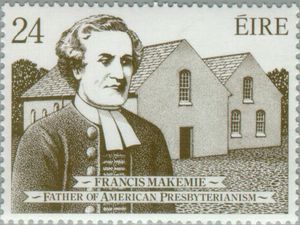
His face is on an Irish postage stamp, a famous historical painting, and on a statue that still stands in Accomac, Virginia. He is the "Father of American Presbyterianism," but how do we really know what Francis Makemie looked like? In fact, a painting was made of both Makemie and his wife while they were still living, presumably, but sadly they were lost in a fire in a Washington, DC neighborhood in 1831. All modern pictorial representations of Francis Makemie antedate the fire; therefore, his true likeness may have escaped our view. Yet, the story of the lost Makemie pictures, as told by Kirk Mariner, gives us intriguing hints that his spirit may have indeed been captured by the pictures we have today. In any case, Makemie is worthy of remembrance for his legacy still lives on.
Labels:
Art,
Church History,
Francis Makemie,
Kirk Mariner,
Painting,
Presbyterian
Sunday, March 6, 2011
A Puritan Art Mystery
There are questions surrounding a work of art to which I have been unable to ascertain the answers. Perhaps a kind reader will be able to help.
The questions pertain to a portrait said to be that of English-American Puritan John Davenport (1597-1670), who co-founded New Haven, Connecticut. Davenport is a link in the chain between Matthew Poole, who began a project to record "illustrious providences," and Increase Mather, who published in 1684 his own "Remarkable Providences," having been given Poole's notes by Davenport.
The portrait shown in the Wikipedia entry for John Davenport is held at the Yale University Art Gallery (and is viewable online here). The curators there have not responded to my inquiry. At one time the subject of this painting was said to be one Francis Higginson (d. 1630), according to The Diary of William Bentley, Vol. 3, p. 52. It was in the 20th century, according to what I have read, that the painting was identified as that of John Davenport.
However, the painting also bears a strong resemblance to one found in Samuel Eliot Morrison, Builders of the Bay Colony (1930), p. 122, which Morrison identifies as representing John Wheelwright (1592-1679). Wheelwright's picture (the same as that found in Morrison's book) may be viewed here. Wheelwright was banished from the Massachusetts colony in November 1637, along with his sister-in-law Anne Hutchinson.
The artist of the work is unknown; for shorthand, he is referred to by art students and scholars as the "Davenport Limner." The date of the work is thought to be around 1670, but that too is unknown.
Aside from the question of the proper identity of the subject of this portrait, whether Davenport or Wheelwright, a further art history wrinkle comes into play with a statement found in Davenport's Wikipedia entry:
Elsewhere, another source says:
Is this mere speculation, or is there some substantive reason to give credence to this line of thought? I am unable to say at this point in time, but the possibility is intriguing.
As an amateur art sleuth, I am left with the following questions:
1. Is the painting held at Yale University's Art Center accurately said to be that of John Davenport, or might it be that of John Wheelwright?
2. Is it possible that some of Rembrandt's famous self-portraits might be, in fact, portraits of John Davenport?
The questions pertain to a portrait said to be that of English-American Puritan John Davenport (1597-1670), who co-founded New Haven, Connecticut. Davenport is a link in the chain between Matthew Poole, who began a project to record "illustrious providences," and Increase Mather, who published in 1684 his own "Remarkable Providences," having been given Poole's notes by Davenport.
The portrait shown in the Wikipedia entry for John Davenport is held at the Yale University Art Gallery (and is viewable online here). The curators there have not responded to my inquiry. At one time the subject of this painting was said to be one Francis Higginson (d. 1630), according to The Diary of William Bentley, Vol. 3, p. 52. It was in the 20th century, according to what I have read, that the painting was identified as that of John Davenport.
However, the painting also bears a strong resemblance to one found in Samuel Eliot Morrison, Builders of the Bay Colony (1930), p. 122, which Morrison identifies as representing John Wheelwright (1592-1679). Wheelwright's picture (the same as that found in Morrison's book) may be viewed here. Wheelwright was banished from the Massachusetts colony in November 1637, along with his sister-in-law Anne Hutchinson.
The artist of the work is unknown; for shorthand, he is referred to by art students and scholars as the "Davenport Limner." The date of the work is thought to be around 1670, but that too is unknown.
Aside from the question of the proper identity of the subject of this portrait, whether Davenport or Wheelwright, a further art history wrinkle comes into play with a statement found in Davenport's Wikipedia entry:
While in Holland, it is believed that he was the model for several portraits by Rembrandt, which are now thought to be self portraits of Rembrandt.
Elsewhere, another source says:
It is a possibility that many of the so-called "self portraits" that Rembrandt did of himself, were in fact portraits of Davenport since Rembrandt was sometimes known to associate with those who ministered to the destitute, and known pictures of John Davenport bear a striking resemblance to Rembrandt Harmenszoon van Rijn.[citation needed] The portrait that accompanies this article purports to have been done during Davenport's lifetime, although it is dated to 1670 when he died.
Is this mere speculation, or is there some substantive reason to give credence to this line of thought? I am unable to say at this point in time, but the possibility is intriguing.
As an amateur art sleuth, I am left with the following questions:
1. Is the painting held at Yale University's Art Center accurately said to be that of John Davenport, or might it be that of John Wheelwright?
2. Is it possible that some of Rembrandt's famous self-portraits might be, in fact, portraits of John Davenport?
Wednesday, November 24, 2010
The Landing of the Pilgrims
Felicia Hemans, "The Landing of the Pilgrims":The breaking waves dashed high
On a stern and rock-bound coast,
And the woods against a stormy sky
Their giant branches tossed.
And the heavy night hung dark
The hills and waters o'er,
When a band of exiles moored their bark
On the wild New England shore.
Not as the conqueror comes,
They, the true-hearted, came;
Not with the roll of the stirring drums,
And the trumpet that sings of fame.
Not as the flying come,
In silence and in fear;
They shook the depths of the desert gloom
With their hymns of lofty cheer.
Amid the storm they sang,
And the stars heard, and the sea,
And the sounding aisles of the dim woods rang
To the anthem of the free!
The ocean eagle soared
From his nest by the white wave's foam;
And the rocking pines of the forest roared,--
This was their welcome home!
There were men with hoary hair,
Amid that pilgrim band;
Why had they come to wither there,
Away from their childhood's land?
There was woman's fearless eye,
Lit by her deep love's truth;
There was manhood's brow serenely high,
And the fiery heart of youth.
What sought they thus afar?
Bright jewels of the mine?
The wealth of seas, the spoils of war?--
They sought a faith's pure shrine!
Ay! call it holy ground,
The soil where first they trod:
They have left unstained what there they found,
Freedom to worship God.
Labels:
Edward Moran,
Felicia Hemans,
Painting,
Pilgrims,
Poetry
Saturday, July 17, 2010
The Rediscovery of Jacques Le Moyne
On a humid day in July, I drove through Northern Virginia horse country to keep an appointment at the Oak Spring Garden Library in Upperville, Virginia, to view the private botanical art and rare book collection of Mrs. Rachel Mellon. The staff welcomed me warmly and treated me to an experience that I will never forget. Along with a tour of the vast holdings of Mrs. Mellon, who personally designed the Jacqueline Kennedy Garden, and who will turn 100 years old next month, I was privileged to hold in my hands the one and only complete edition of the only book published by French Huguenot artist Jacques Le Moyne de Morgues, La Clef des Champs (1586).La Clef des Champs is a pattern book, designed to provide archetypical samples of various flora, fauna and animals for use in embroidery, tapestry and needlework. It was published at the end of Le Moyne's life and illustrates his remarkable skill at bringing creation to life through watercolor. It was dedicated to his patroness, Lady Mary Sidney, wife of Sir Henry Sidney, confidante of Queen Elizabeth I, and mother of the famous poet Sir Philip Sidney, and begins with a dedicatory epistle and a sonnet dedicated to her, one of several that Le Moyne was known to write. As I leafed through the pages, I was struck by the vividness of the color, still striking after over 400 years, and the attention to detail by this master. They are, as Wilfrid Blunt described, "a labour of love" (The Art of Botanical Illustration: An Illustrated History, p. 82). Two other manuscripts among the library's holdings attributed to him reaffirmed to me his amazing gift. One was especially noteworthy for his inclusion of roots in his floral works. These represent a significant portion of his extant works. What is especially remarkable is that but for the providence of God, Le Moyne would have been remembered only as one of the first French Huguenot martyrs in America.
Le Moyne was born in 1533 in Dieppe, France, both a prominent seaport and a Huguenot stronghold. Little is known about his early years. Miles Harvey hypothesizes that his father was the Catholic embroiderer and friend of Mary, Queen of Scots, Henry Le Moyne. He must have had connections to the royal court because he was invited to join the 1564 Florida expedition of Lt. René de Laudonnière, serving as the royal cartographer and artist for the voyage. He wrote a narrative of his experiences upon his return home at the personal request of King Charles IX to accompany his remarkable artwork. His account is one of a few invaluable sources which inform us of life at Fort Caroline, the third French Huguenot colony in the Americas (France Antarctique in Brazil (1555-1567) and Charlesfort, South Carolina (1562) were the first), and his artwork serves as the first European depictions of American Indians, the Timucua. His maps also fill an important role in the cartographical history of the United States. He survived the infamous Spanish massacre of Fort Caroline on September 20, 1565, by fleeing the fort and making a return voyage which landed him in England first, then overland to France. It is thought that he lost his artwork when he was forced to flee Fort Caroline suddenly, and then recreated his drawings on the return voyage or sometime thereafter, but Harvey speculates that he perhaps salvaged some of his notes at least.
Some time later, after fleeing France following the 1572 St. Bartholomew's Day Massacre, he entered the service of Sir Walter Raleigh, and became acquainted with John White, an artist who later famously served as Governor of the Lost Colony of Roanoke Island, North Carolina. White was influenced artistically by the French Huguenot. Le Moyne died in May 1588, and was buried at Blackfriars Parish. His wife Jeane survived him by several years, but it does not appear that their son did. Towards the end of his life, Le Moyne made the acquaintance of Theodore de Bry, Belgian engraver, who had a vision to promote the exploration and colonization of America. De Bry sought to obtain Le Moyne's paintings for publishing but they were unable to come to terms; after Le Moyne's death, De Bry purchased them from Jeane, and subsquently published engravings based on the artwork of both John White and Jacques Le Moyne, which became sensational best-sellers in his day, and contributed greatly towards the early 17th century European migration to America.
However, Le Moyne himself faded into obscurity as an artist, as did the story of the Fort Caroline colony and its role in the building of America. It was not until the late 19th century that Americans began to realize that French Protestants had preceded English Protestants in settling this nation. It was not until 1900 that Le Moyne's art began to be identified as his, when his illustration of The Indian Chief Athore showing Laudonniere the Marker Column set up by Ribault was positively attributed to him (now in the possession of the New York Public Library), and notice was taken of its importance in art history. In 1922, Spencer Savage, librarian of the Linnean Society, realized that a collection of watercolor plants owned by the Victoria and Albert Museum was in fact the work of Le Moyne. This attribution paved the way for further attributions to Le Moyne, and stirred 20th century interest in the man himself, who lived such an interesting life and created such beautiful art. The world's rediscovery of Jacques Le Moyne has enriched our understanding of art and world history in so many ways.
His art may now be found in a few places around the world: the British Museum and the Victoria and Albert Museum in London; the New York Public Library; the Yale Center for British Art in New Haven, Connecticut; Dumbarton Oaks, Washington, DC; and the Oak Spring Garden Library in Upperville, Virginia.
Le Moyne himself found pleasure in recreating the artwork of his God, as he wrote in a poem once, calling us to elevate our minds from the creation to the Creator:
Seek no more the colors of a gay Spring
which in the living flowers fade in an hour
here sweet Flora remains in her beauty
and does not lose her distinction through the rigors of time.
Saturday, May 15, 2010
Like a Man Who Gropes in the Dark
A young man trained in the art of glass-painting, Bernard Palissy was once shown an enamel cup of such exquisite beauty that he was forever captivated. He set about trying to learn the art behind the creation, seeking to discover the secrets of Chinese porcelain. He was like a man "groping in the dark." He wrote in his autobiography:
An earthen cup was shown to me turned and enamelled of such beauty that henceforth...seeing they were beginning to give them up in the country where I lived, and also that glazing was not in great request, I thought that if I could discover the invention of making enamels I should be able to make vessels of earth and other things of beautiful arrangement, because Heaven had given me to understand something of painting; and thenceforth, without considering that I had no knowledge of argillaceous earth, I set about seeking enamels like a man who gropes in the dark.
No European could train him in this art; he would spend the next sixteen years of his life endeavoring to unlock the key. He had seen a specimen and knew it was possible, but the failed attempts to recreate it multiplied. His wife and children suffered with him, as he spent money on supplies to no avail. Poverty overwhelmed him, forcing him to subsist on money earned by the spare glass-painting work he did to make ends meet while he took up floorboards to keep his kiln burning as he slowly began to master the craft of pottery. Somehow, along the way, he invented what is now known as Palissy ware, a style of polychrome lead-glazed earthenware often incorporating animal motifs, that has been long admired and copied.
The French Huguenot potter, who was imprisoned several times for his faith during his lifetime and died in the Bastille after his court protectors could no longer shield him from persecution, never did quite unlock the secret of that Chinese porcelain, but instead he paved a new way and created an art form all his own. The light and legacy of the man who spent sixteen years groping in the dark shines on.
Labels:
Art,
Bernard Palissy,
Church History,
Huguenot,
Painting,
Pottery
Saturday, May 8, 2010
The Art of Edwin White
A descendant of Elder John White, one of the founders of Hartford, Connecticut, Edwin White had a particular interest in historical paintings of religious significance; besides the Pilgrim scenes referenced above, he also painted the Pilgrims' First Thanksgiving and Separation of the Pilgrims at Delft Haven; Bunyan's Dream; The First Printing of the Bible; The Emigrants' Sabbath; The Sacred Lesson; A Morning With Luther; Luther's Vow; The Death-Bed of Luther; Landing of the Huguenots at the Mouth of the St. John's River, 1564; and Evening Hymn of the Huguenot Refugees (which has been reproduced on notecards by the National Huguenot Society).
White's paintings bring alive some of the most significant moments of history, and combining an interest in our Protestant heritage, with his exquisite skill, his legacy is worthy of remembrance.
Labels:
Art,
Church History,
Edwin White,
Huguenot,
John White,
Martin Luther,
Painting,
Pilgrims,
Pocahontas
Wednesday, April 21, 2010
Protestant Iconoclasm and Art Appreciation
Contrary to Islamic aniconism, which prohibits the representation of living creatures in art, Protestant iconoclasm, mistaken interpretations notwithstanding, has not opposed visual and aesthetic art en masse, but only sought to channel it in ways that accord with the second and seventh commandments. Geraldine Jean Wheeler, Visual Art, the Artist and Worship in the Reformed Tradition: A Theological Study (2003 dissertation), pp. 9-10, writes:
Likewise, the charge that the Puritans were "fanatical Philistines, apostles of gloom, utterly antagonistic to the arts and music" as well as "tone-deaf and colour-blind iconoclasts" has been ably refuted by others.
One need only look closely at the works of Calvin and his followers to see the distinction between opposing ungodly art and allowing art its freedom to blossom within ethical boundaries. Illustrations abound in the Geneva Bible; Huguenot craftsmen such as the potter Bernard Palissy thrived under the Calvinistic appreciation of the arts; the Dutch Golden Age is renowned for its visual arts. The first paintings of Native North Americans were made by Jacques Le Moyne, the French Huguenot painter who survived the Spanish massacre of Fort Caroline, near modern-day Jacksonville, Florida, in 1565. Theodore Beza's classic work, Icones, was not a treatise against images in church, but a collection of biographies of ecclesiastical leaders, accompanied by pictures, or images, of these men. The list goes on...
John Calvin, Institutes 1.11.12:
John Calvin, Catechism of Geneva (1545), quoted in James T. Dennison, Jr., ed., Reformed Confessions of the 16th and 17th Centuries in English Translation, Vol. 1, pp. 487-488 [on the second commandment]:
Heidelberg Catechism (1563):
In spite of the widely held view, expressed by Voltaire27 and many others, that Calvin, Geneva and the whole following tradition eschewed art, this can be shown to be misplaced.
27 Quoted in [Jérôme] Cottin, Le regard et la Parole, p. 285, n. 1.
Likewise, the charge that the Puritans were "fanatical Philistines, apostles of gloom, utterly antagonistic to the arts and music" as well as "tone-deaf and colour-blind iconoclasts" has been ably refuted by others.
One need only look closely at the works of Calvin and his followers to see the distinction between opposing ungodly art and allowing art its freedom to blossom within ethical boundaries. Illustrations abound in the Geneva Bible; Huguenot craftsmen such as the potter Bernard Palissy thrived under the Calvinistic appreciation of the arts; the Dutch Golden Age is renowned for its visual arts. The first paintings of Native North Americans were made by Jacques Le Moyne, the French Huguenot painter who survived the Spanish massacre of Fort Caroline, near modern-day Jacksonville, Florida, in 1565. Theodore Beza's classic work, Icones, was not a treatise against images in church, but a collection of biographies of ecclesiastical leaders, accompanied by pictures, or images, of these men. The list goes on...
John Calvin, Institutes 1.11.12:
12. I am not, however, so superstitious as to think that all visible representations of every kind are unlawful. But as sculpture and painting are gifts of God, what I insist for is, that both shall be used purely and lawfully,—that gifts which the Lord has bestowed upon us, for his glory and our good, shall not be preposterously abused, nay, shall not be perverted to our destruction. We think it unlawful to give a visible shape to God, because God himself has forbidden it, and because it cannot be done without, in some degree, tarnishing his glory. And lest any should think that we are singular in this opinion, those acquainted with the productions of sound divines will find that they have always disapproved of it. If it be unlawful to make any corporeal representation of God, still more unlawful must it be to worship such a representation instead of God, or to worship God in it. The only things, therefore, which ought to be painted or sculptured, are things which can be presented to the eye; the majesty of God, which is far beyond the reach of any eye, must not be dishonored by unbecoming representations. Visible representations are of two classes—viz. historical, which give a representation of events, and pictorial, which merely exhibit bodily shapes and figures. The former are of some use for instruction or admonition. The latter, so far as I can see, are only fitted for amusement. And yet it is certain, that the latter are almost the only kind which have hitherto been exhibited in churches. Hence we may infer, that the exhibition was not the result of judicious selection, but of a foolish and inconsiderate longing. I say nothing as to the improper and unbecoming form in which they are presented, or the wanton license in which sculptors and painters have here indulged (a point to which I alluded a little ago, supra, s. 7). I only say, that though they were otherwise faultless, they could not be of any utility in teaching.
John Calvin, Catechism of Geneva (1545), quoted in James T. Dennison, Jr., ed., Reformed Confessions of the 16th and 17th Centuries in English Translation, Vol. 1, pp. 487-488 [on the second commandment]:
144. M[inister]. Does He entirely forbid us to make any image?
C[hild]. No, but He forbids us to make any image with which to represent God, or to worship Him.
148. M. This does not mean that all sculpture or painting is universally forbidden, but only all images used in the service of God, or in worshipping Him in visible things, or indeed for any abuse of them in idolatry of any kind whatsoever.
C. That is so.
Heidelberg Catechism (1563):
Question 96. What does God require in the second commandment?
Answer: That we in no wise represent God by images, nor worship him in any other way than he has commanded in his word.
Question 97. Are images then not at all to be made?
Answer: God neither can, nor may be represented by any means: (a) but as to creatures; though they may be represented, yet God forbids to make, or have any resemblance of them, either in order to worship them or to serve God by them.
Question 98. But may not images be tolerated in the churches, as books to the laity?
Answer: No: for we must not pretend to be wiser than God, who will have his people taught, not by dumb images, but by the lively preaching of his word.
Monday, January 4, 2010
Four Standards of Judgment
Francis Schaeffer poses and then answers the question "What kind of judgment does one apply, then, to a work of art?" in Art & Bible, pp. 41-48:
I believe that there are four basic standards: (1) technical excellence, (2) validity, (3) intellectual content, the world view which comes through and (4) the integration of content and vehicle.
I will discuss technical excellence in relationship to painting because it is easy to point out through this medium what I mean. Here one considers the use of color, form, balance, the texture of the paint, the handling of the lines, the unity of the canvas and so forth. In each of these there can be varying degrees of technical excellence. By recognizing technical excellence as an aspect of an art work, we are often able to say that while we do not agree with such and such an artist's world view, he is nontheless a great artist.
We are not being true to the artist as a man if we consider his art work junk simply because we differ with his outlook on life. Christian schools, Christian parents and Christian pastors often have turned off young people at just this point. Because the schools, the pastors and the parents did not make a distinction between technical excellence and content, the whole of much great art has been rejected by scorn or ridicule. Instead, if the artist's technical excellence is high, he is to be praised for this, even if we differ with his world view. Man must be treated fairly as man. Technical excellence is, therefore, an important criterion.
Validity is the second criterion. By validity I mean whether an artist is honest to himself and to his world view or whether he makes his art only for money or for the sake of being accepted. If an artist makes an art work solely for a patron -- whether that patron is the ancient noble, or the modern art gallery to which the artist wants access, or the modern art critics of the moment -- his work does not have validity. The modern forms of "the patron" are more destructive than even that of the old noble.
...
The third criterion for the judgment of a work of art is its content, that which reflects the world view of the artist. As far as a Christian is concerned, the world view that is shown through a body of art must be seen ultimately in terms of Scripture. The artist's world view is not to be free from the judgment of the Word of God. In this the artist is like a scientist. The scientist may wear a white coat and be considered an "authority" by society, but where his statements impinge upon what God has given us in Scripture, they come under the ultimate authority of his Word. An artist may wear a painter's smock and be considered almost a holy man, yet where his work shows his world view, it must be judged by its relationship to the Christian world view.
I think we can now see how it is possible to make such judgments concerning the work of art. If we stand as Christians before a man's canvas and recognize that he is a great artist in technical excellence and validity -- if in fact he is -- if we have been fair with him as a man and as an artist, then we can say that his world view is wrong. We can judge this view on the same basis as we judge the views of anybody else -- the philosopher, common man, laborer, businessman or whatever.
...
There is a corollary to this third criterion. We should realize that if something untrue or immoral is stated in great art it can be far more destructive and devastating than if it is expressed in poor art or prosaic statement. Much of the crude art, the common product of hippie communities and the underground press, is laden with destructive messages, but the art is so poor that it does not have much force. But the greater the artistic expression, the more important it is to consciously bring it and its world view under the judgment of Christ and the Bible.
...
There is a second corollary related to judging the content of an art work: It is possible for a non-Christian writer or painter to write and paint according to a Christian world view even though he himself is not a Christian. To understand this, we must distinguish between two meanings of the word Christian. The first and essential meaning is that a Christian is a man who has accepted Christ as his Savior and has thus passed from death to life, from the kingdom of darkness to the kingdom of God by being born again. But if a number of people really are Christians, then they bring forth a kind of consensus that exists apart from themselves, and sometimes non-Christians paint and write within the framework of that consensus even though they as individuals are not Christians.
There are, therefore, four kinds of people in the realm of art. The first is the born-again man who writes and paints within the Christian total world view. The second is the non-Christian who expresses his own non-Christian world view. The third is the man who is personally a non-Christian but nevertheless writes or paints on the basis of the Christian consensus by which he has been influenced....
The fourth person is the born-again Christian who does not understand what the total Christian world view should be and therefore produces art which embodies a non-Christian world view. In other words, just as it is possible for a non-Christian to be inconsistent and to paint God's world in spite of his personal philosophy, it is possible for a Christian to be inconsistent and embody in his paintings a non-Christian world view. And it is this latter which is perhaps the most sad.
The fourth criterion for judging a work of art involves how well the artist has suited the vehicle to the message. For those art works which are truly great, there is a correlation between the style and the content. The greatest art fits the vehicle that is being used to the world view that is being presented.
...
We should ultimately see all art works in the light of their technique, validity, world view and suiting of form to content.
Labels:
Art,
Common Grace,
Francis Schaeffer,
Music,
Painting
Monday, September 21, 2009
Puritan Portraits
Just a tip for those who may be seeking portraits online of select Puritans. Dr. Don Kistler has provided a helpful resource based on his own research in collecting Puritan portraits and making them available at his website here. Enjoy!
Labels:
Art,
Don Kistler,
Painting,
Puritan
Wednesday, August 26, 2009
Age of Chiaroscuro
Hughes Oliphant Old, "Matthew Henry and the Puritan Discipline of Family Prayer," Calvin Studies VII (Davidson College: 1994), p. 79:
[Matthew] Henry's prayers of confession do not really live up to what our age has been taught to expect from the Puritan. One does not find his dwelling on sin pathological or morose. One finds that his dwelling on sin is well balanced by his dwelling on God's mercy. The seventeenth century was, after all, the age of chariscuro [chiaroscuro]. It was Rembrandt's resonant browns and blacks which made his golds and whites so brilliant. If they could be so realistic about the blackness of sin, it was because they were dazzled by the radiance of God's grace.
Labels:
Art,
Hughes Oliphant Old,
Matthew Henry,
Painting,
Prayer,
Puritan,
Rembrandt van Rijn
Subscribe to:
Posts (Atom)
